An Artistic Agenda: It’s important to schedule and protect writing time.
Asking an artistic person to organize their day is like starting with a blank sheet of paper, but ending up with an Escher-esque drawing.
It was fun in a tangential sort of way, but it took time away from your dedicated writing goals.
If you’re highly distractable, your challenges are multiplied, but that doesn’t mean you can’t use that to your advantage.
Time management skills are often discovered under fire.
Save yourself stress by learning from other people who have created effective strategies to meet their time management goals.
MindMups:
MindMups are more addictive than bubble-wrap.
It’s a mash-up of computerized doodling with mind maps .
If you need to connect your story segments into ‘The Big Picture,’ while keeping all of your sub-plots and character arcs straight, this is worth a try.
There is a free version and paid subscription. https://www.mindmup.com/tutorials/storyboard.html
Mirror:
Sticky notes on a bathroom mirror.
Yellow stickies for morning.
Green for afternoon.
Blue for evening.
Each time you accomplish your sticky goal, take it off the mirror and put in a cumulative paper someplace where you can be reminded of your daily accomplishments.
Matchy-Matchy:
Color-coordinate your working materials according to task.
Example: In a perfect world, I’d like all blog writing materials to be in color schemes that remind me of campfires.
I used green for my novel that takes place in the summer.
Blue for my winter tale.
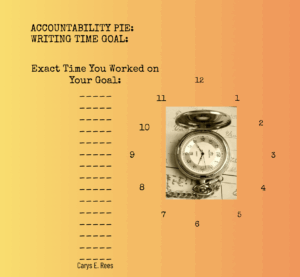
Pie Charts: Also known as an Accountability Pie:
Goal-setting is factored into this style of scheduling.
(#1) Use one plain sheet of paper and draw a large circle on it with a dot in the middle.
(#2) Measure out with equal spacing, incrementally penciled dots around the perimeter.
You need to have twenty-four dots.
(#3) Connect each of these twenty four dots to the center point.
(#4) Fill in the outside dots like a clock, but with one dot spaced between.
(#5) On the top of this page, write your time management goals. (#6) On the side, record exactly when you worked on these goals.
(#7) Color these time blocks accordingly.